
What Should a Change Management for ISO 22301 Contain?
Change management is an essential part of ISO 22301, the Business Continuity Management System (BCMS) standard. An effective change management process ensures that changes to the BCMS and related processes are handled in a controlled and systematic manner.
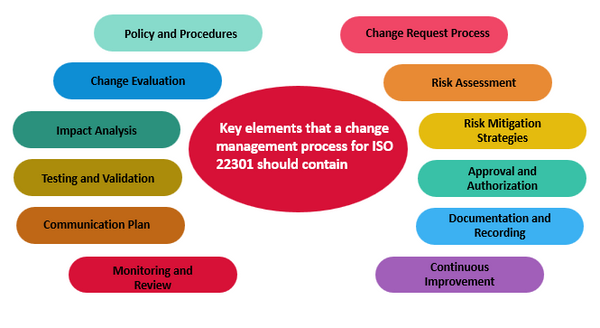
Here's a structured list of what a change management process for ISO 22301 should generally contain:
Change management for ISO 22301, which is the international standard for Business Continuity Management Systems (BCMS), is crucial to ensure that changes in an organization do not adversely impact its ability to maintain critical operations during disruptions. Here are the key elements that a change management process for ISO 22301 should contain:
- Define a clear change management policy within the context of the ISO 22301 BCMS framework.
- Document detailed procedures for requesting, evaluating, implementing, and communicating changes.
Change Request Process:
- Establish a standardized process for submitting change requests. This process should include necessary documentation and justification for the change.
Change Evaluation:
- Assign responsibilities for evaluating proposed changes. This might involve a cross-functional team to assess potential risks and impacts.
- Evaluate each change against BCMS objectives, critical processes, and resilience goals.
Risk Assessment:
- Conduct a risk assessment for each proposed change to identify potential impacts on business continuity.
- Assess the change's potential to introduce vulnerabilities or disrupt critical functions.

Impact Analysis:
- Perform a thorough analysis of the potential impact of the change on business operations, information systems, and resources.
- Consider both immediate and long-term effects of the change.
- Develop risk mitigation strategies to address identified risks associated with the change.
- Identify control measures, safeguards, or alternative processes to minimize potential disruptions.
Testing and Validation:
- Determine whether the change can be effectively tested in a controlled environment before implementation.
- Perform testing to verify that the change does not negatively affect business continuity capabilities.
Approval and Authorization:
- Define the approval process for changes, including roles and responsibilities of decision-makers.
- Determine criteria that a change must meet before it can be authorized for implementation.
Communication Plan:
- Develop a communication plan to inform relevant stakeholders about upcoming changes and their potential impacts.
- Ensure timely and transparent communication to minimize confusion and resistance.
Documentation and Recording:
- Maintain a record of all change requests, evaluations, decisions, and outcomes.
- Document the rationale for approving or rejecting changes.
- Training and Awareness:
- Provide training to employees and relevant personnel about the change management process and their roles.
- Raise awareness about the importance of managing changes to maintain business continuity.
Monitoring and Review:
- Establish a mechanism for monitoring implemented changes and their effects on business continuity.
- Conduct periodic reviews to assess the effectiveness of the change management process and identify areas for improvement.
Continuous Improvement:
- Use feedback from change implementation and post-implementation reviews to continuously improve the change management process.
- Adapt the process based on lessons learned and changing organizational needs.

Implement ISO Faster with a Complete Documentation System
ISO Toolkit for Your Standard
Pick your toolkit from 8 ready-to-use ISO toolkits available: ISO 27001, 9001, 14001, 45001, 22301, 20000, and 42001 (AI Governance).
✔ Complete ISO documentation framework
✔ Policies, procedures, templates, and records
✔ Risk management & internal audit templates
✔ Management Review and Nonconformance
✔ ISO Standard Mapped Implementation Plan
💡 All toolkits come with instant download, one-time payment, and unlimited email & chat support.
ISO PowerPack Bundle
Designed for teams, organizations, and consultants managing multiple ISO implementations across projects and clients.
✔ Unlimited internal and client use
✔ Deliver ISO services from day one
✔ Impress clients and auditors
✔ Skip months of document creation
✔ Grow your consulting business
💡All the benefits of our ISO toolkits combined in one powerful bundle — save over $1,000 compared to buying the toolkits individually.
